Saturday, February 3, 2024

Anthropologist Profile: Dr. Darius Bittle-Dockery


Dr. Darius Bittle-Dockery (Image Source: LinkedIn)

Can you recall a time when you or someone you know was asked what you want to do with your life, and you had difficulties answering that question?  Perhaps the answer was difficult to come up with because it was new and not something that had been seriously considered previously.  Or the answer was difficult to specify because of the variety of interests and goals that one wanted to achieve, paralyzing one by the possibilities and options available to them.  I bring this latter point up because one of the wonderful things about anthropology, which can be simplified to the study of people, is that it allows one to explore various different interests, so long as those interests involve people in some way.  Today’s anthropologist being profiled in this blog post exemplifies this point.  Dr. Darius Bittle-Dockery has led quite a vibrant career over his lifetime, demonstrating how anthropology can open doors to different opportunities and allow for the exploration of many interest.


Dr. Darius Bittle-Dockery earned his Bachelor of Arts degree in Anthropology, with a minor in Philosophy, from Tufts University (Massachusetts) in 2010.  As an undergraduate student he took the opportunity to pursue independent, grant sponsored research through the National Science Foundation.  His project enabled him to use his cultural anthropological experience to better understand the relationships among disc jockeys, the music industry, and listeners to gain a greater understanding of society and mass media. 


This was his first foray into anthropological research, but it was not his first experience doing something on his own. In 2008 Bittle-Dockery became the brainchild of a company, DNA Custom Productions.  He started the apparel company by drawing designs in his home. He later teamed up with two of his classmates, Andres Naim and Ben Betcher, and they grew the company, which catered to mass produced apparel with custom designs.  They marketed their products to various campus organizations and groups at Tufts University, which made up the bulk of their customer base.  Bittle-Dockery credited the company’s success to superior customer service and a price match guarantee.  The three students enjoyed their work and they wanted to provide quality products that satisfied their customers’ wants and needs.  While they were not focused on making a huge profit their company netted a modest $25,000 in gross revenue every semester.  Ultimately, the company was sold almost two years after they started it for almost ten times their initial investment.


After graduating from Tufts University Bittle-Dockery joined the Peace Corps, where he was stationed in rural Jordan.  Here he was responsible for providing training and education to local residents on technology.  He and his fellow Peace Corps volunteers set up computers and related technology, and then they provided instruction to individuals of all ages on how to use that newly installed technology.  This may very well have been part of the inspiration for Bittle-Dockery’s doctoral research. 


That would not come about until several years later.  He bounced among various jobs before joining the University of Pittsburgh’s doctoral program.  His positions varied as he worked in business, nonprofits, and international non-governmental organizations, but they focused largely on research, grant writing, and user services.  All these experiences were later put toward his doctoral pursuits, which drew upon various theoretical approaches and ethnographic methods in assessing the connections among communication technology, information networks, and chronic disease among Syrian refugees in Jordan.  In addition to his research he amassed several awards and served in various professional organizations.  In 2022 he graduated with two degrees from the University of Pittsburgh: a Ph.D. and a M.P.H. in Medical Anthropology and Behavioral & Community Health Sciences, respectively. 


What is Dr. Bittle-Dockery up to these days?  Well, a couple of things.  He is currently the VP, Senior Experience Strategist for PNC, a bank based in Pittsburgh.  He also works on projects related to improving financial literacy and providing professional mentorship among BIPOC youth with Project Come Up.  He remains interested in his research, with his interests in medical anthropology, surveillance studies, and human ecology (the study of how environment, biology, technology, and demographics affect human cultures and systems).  It will be interesting to see where his experiences and his interests take him as he continues in his varied but fruitful career.


Bibliography

Bittle-Dockery, D. (2023, December 11). Darius Bittle-Dockery. Retrieved from Department of Anthropology, University of Pittsburgh: https://www.anthropology.pitt.edu/people/darius-bittle-dockery

Bittle-Dockery, D. (n.d.). Darius Bittle-Dockery, LinkedIn Profile. Retrieved from LinkedIn: https://www.linkedin.com/in/dariusbdockery/

The Tufts Daily. (2008, October). If the shirt fits, customize it, order it, wear it. The Tufts Daily, p. 1.


Saturday, January 27, 2024

Applied Anthropologist Profile: Kerri Klein, Applied Anthropology Graduate Student & Founder of the Burial Hill 3D Digitization Project

Kerri Klein photographing a tombstone at Burial Hill Cemetery (Source: Anya Gruber)


Archaeology focuses on the study of the material culture to understand lifeways and cultures of the past.  Archaeological evidence can be used to support already documented historical evidence, or it can serve as the sole piece of historical evidence.  Sometimes it can be both.  This is the case for the Burial Hill Cemetery site in Plymouth, Massachusetts.  Situated on the ancestral lands of the Wampanoag Indians and the former site of early colonists’ long since abandoned settlement this cemetery is a great source of historical and archaeological information pertaining to both known and yet to be discovered and/or investigated histories.  This information, however, is at great risk of loss through natural and man-made forces, which is in part why applied anthropology doctoral student Kerri Klein initiated the Burial Hill 3D Digitization Project.


Klein, who is from the area, was always interested in learning more about her community’s local history, leading her to pursue a preservation project of the Burial Hill Cemetery.  The cemetery had only been recently (as of 2015) been listed under the National Register for Historic Places, which encouraged greater attention and emphasis on the cemetery’s preservation, but up until that point the cemetery had undergone damage from both natural and man-made forces.  Klein decided to pursue her doctoral studies in applied anthropology under the supervision of Antoinette Jackson, an anthropologist at the University of South Florida.  Jackson is also the founder of The Black Cemetery Network, an organization committed to protecting historically Black cemeteries.  Klein drew upon Jackson’s work to begin documenting and preserving the cemetery’s tombstones through photographs in order to utilize the photogrammetry method, which is a means of using 2-dimensional photographs to recreate 3-dimensional (3D) images and models.     


Klein’s interests eventually grew into the Burial Hill 3D Digitization Project.  Klein was inspired to pursue this project when she working at the site and was approached by a blind woman and her daughter.  They wanted to know where a specific memorial at the cemetery was located, which Klein guided them to.  She realized that the pathway was inaccessible for individuals with mobility or sight issues, such as was the case for the blind woman who requested her assistance.  The mother and daughter managed to get to the monument, thereby learning and enjoying the history and information associated with it.  This experience inspired Klein to want to increase the accessibility to the site, particularly for those who could not access it due to mobility/ability challenges or who lacked the financial means of getting to the cemetery.  This project also serves an additional purpose: it preserves the tombstones for study by scholars and members of the public.


Klein’s project began in 2021 and requires her to photograph all 2300 gravestones present at the site.  The scope and size of the cemetery is too large of an undertaking for just Klein, so she enlists the aid of family members and volunteers associated with the Friends of Burial Hill organization.  She trains volunteers to take the necessary photographs, which must be taken from several angles to recreate the three dimensional models of the gravestones, using their own phones, making it an easy and worthwhile project for those interested in the cause. 


As the cemetery is the final resting place for various historical figures, including but not limited to Plymouth Colony governors, notable Revolutionary activists, and important Wampanoag individuals, there is a wealth of historical and cultural information recorded among the tombstones.  Furthermore, the cemetery holds information concerning individuals who have not been well documented, such as African Americans military personnel and civilians interred at the cemetery.   The preservation of their stories and information is key to aiding in discovering, learning, and reinforcing accurate historical narratives concerning not only the area but American histories.  Klein hopes that these untold stories can get the necessary attention required to entice researchers to investigate these neglected histories further, as well as provide greater insights into other subjects, such as the work of stonemasons, the names and histories of the residents throughout the period of use of the cemetery, temporal trends in cemetery use and mortuary styles, epidemic trends, linguistic trends, religious studies, and more.


Klein’s work is already paying off as several tombstones have been fully digitized and 3D models available on the project’s website.  Hopefully, her continued efforts, along with the hard work of dedicated volunteers, will lead to more and greater historical information being learned and shared.


References

CAS Chronicles. (2022, January 21). 3D DIGITAL PRESERVATION OF HISTORICAL CEMETERY OF EARLY AMERICANS . Retrieved from CAS Chronicles: https://www.usf.edu/arts-sciences/hub/2022/3d-digital-preservation-of-historical-cemetery-of-early-americans.aspx

Gruber, A. (2023, March 30). Can Digitizing Gravestones Save History? Sapiens.

Steinberg, J. (2014, June 19). Plymouth Burial Hill 3D View of Excavation Unit 3. Retrieved from The Fiske Center Blog: https://blogs.umb.edu/fiskecenter/2014/06/19/plymouth-burial-hill-3d-view-of-excavation-unit-3/


Saturday, January 20, 2024

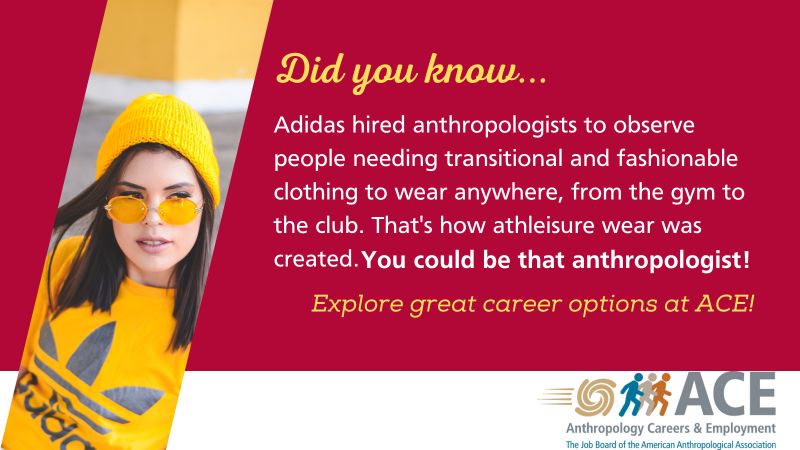
A Profitable Partnership: Anthropology & Adidas


When people think about what sorts of degrees are needed to enter into any business industry they more often than not think of the obvious options: business degrees.  While this remains true there are various other ways that individuals interested in working in business can go about doing so.  Most recently, social scientists, particularly anthropologists, have been in high demand, outpacing the demand for individuals with traditional business degrees.  Various businesses, such as Intel, Microsoft, and Google, are hiring anthropologists to help them better analyze and understand consumer data.  This is because anthropologists bring a skill set that teases out more specific and detailed information that large, traditional methods and data sets cannot pick out, making anthropologists and other related social scientists valuable and in demand resources.  Today’s blog post will focus on one such profitable partnership between anthropologists and the athletic business giant Adidas.


Founded in 1949 Adidas has and continues to remain a competitive company in the creation and marketing of athletic and sporting goods and attire.  From the company’s founding they drew inspiration from various well-known athletes, many of whom received sponsorship and endorsements from the company to help market their products.  Adidas’s design and marketing teams were driven by the idea that competition and athletic prowess drew consumers to their products, and until the early 2000s this idea dominated their mission.  This all changed, though, when VP James Carnes observed everyday people wearing athletic attire outside of the gym.  They were wearing athletic attire while at the coffee shop, while jogging, on their way to yoga class, and more.  Carnes was perplexed by this because he expected his brand to be on athletes, not nonathletic individuals, leading him to investigate this matter further. 


Carnes’s curiosity led to Adidas hiring ReD Associates, a Copenhagen-based consultancy that employs a range of individuals not with business degrees but social science and humanities degrees to dig deeper into consumer patterns and trends.  ReD’s anthropological team trained the Adidas designers in anthropological methods, particularly cultural anthropological methods such as participant observation and interview methods.  The ReD anthropological team also reached out directly to consumers and asked them to take pictures of what motivated them to work out and wear athletic wear.  The ReD anthropological team realized a consistent theme among the surveyed participants photos: they wanted to look sexy based on sociocultural beauty standards.  From an American perspective this promotes a body image of a thin, athletic physique.  Ultimately, this led the ReD anthropologists to conclude that consumers did not want to perform athletically for the purposes of having a competitive edge that enabled them to win; they worked out to maintain a healthy lifestyle and meet the demands of the American beauty norms.


Executives at Adidas realized that they had misjudged a large consumer base, which they were underserving.  They concluded that they did not just have to market to athletes.  They could and should market to the everyday person who wanted to work out to be healthy and beautiful, thereby necessitating a different type of athletic wear and gear.  Adidas stepped up and created their athleisure wear line to meet this consumer demand, making huge profits in the process.


The relationship between Adidas and ReD Associates did not stop there, though.  About a decade later they worked together again, this time to determine how best to create athletic shoes for soccer players.  ReD’s anthropological team interviewed German soccer players to figure out what they needed out of a shoe, realizing a shoe that enhanced performance, particularly speed, was needed.  Soccer shoes were not necessarily built to support that.  The players required a running shoe that was built to assist them in maintaining performance levels to enhance their speed, but these types of shoes are not conducive to the rigorous footwork required of soccer playing.  Adidas took this information and designed a running shoe that could be used on the soccer field, which they debuted in 2010.  The soccer teams that adopted these new hybrid shoes were pleased and impressed, crediting them with giving them the competitive advantage that secured them various wins.  The biggest win was scoring the most goals at the World Cup that happened that year (which to readers unfamiliar with the World Cup is the paramount international competition that any soccer player or team can participate in, demonstrating the positive impression players had on these shoes).


Ultimately, Adidas’s success has inspired companies across various industries to rethink their approaches to creating and marketing their products.  They could no longer rely on their preconceived notions of what the customer wanted and needed; they needed to learn what the customer wanted and needed by better understanding the sociocultural and biocultural environments they exist in, be it for work, pleasure, health, etc.  They began to rethink and revolutionize their previous market survey approaches, which were faulty because they relied on closed-ended questions that limited the scope of information that could be collected from consumers.  They also ran on the assumption that consumers were always truthful in their responses, which is unrealistic, particularly when consumers are surveyed about topics that they feel can and will present them in a negative way if they were completely truthful.  Anthropological methods could bypass these issues by enabling companies to really understand their consumers’ needs and wants, thereby creating and marketing products that they actually want and will use.  This leads to happier and satisfied customers and greater profit margins for the companies.


Works Cited

Baer, D. (2014, March 27). Here's Why Companies Are Desperate To Hire Anthropologists . Business Insider.

Jess the Avocado. (2022, January 25). How Anthropology and Adidas Design Shoes Together. Medium.