Saturday, February 1, 2014

The Real Forensic Anthropology


Thirteen years ago CSI: Crime Scene Investigation premiered and quickly captured the public's attention, becoming one of the most popular shows on television (TV).   This show has inspired several spinoffs and new shows, such as the popular TV show Bones, which was inspired by a book series created by Kathy Reichs, a former forensic anthropologist.  Collectively, these shows have appear to provide a glimpse into the everyday workings of criminal investigations, but what do we really know about forensic sciences and, in particular, forensic anthropology?  Today's blog post is going to provide you with a quick summary of what forensic anthropology is, what forensic anthropologists can and do do, and what it takes to become a forensic anthropologist.
 
Forensic anthropology is the application of the science of physical anthropology and human osteology in a legal setting, most often in criminal cases where the victim's remains are in the advanced stages of decomposition. A forensic anthropologist can assist in the identification of deceased individuals whose remains are decomposed, burned, mutilated or otherwise unrecognizable.  The field of forensic anthropology popularized by shows such as Bones and CSI, but it is a very serious field that can be very exhausting-physically and emotionally-due to the regular interactions with grieving families and law enforcement agents and sometimes working with mass disasters (e.g. September 11, genocides, Prisoner of War excavations, etc.)

Forensic anthropologists are responsible for investigating human skeletal remains to assess if and what type of crime may have occurred in relation to that individual, legally defined as the victim.  Forensic anthropologists go through a series of steps in their assessments, starting with studying the biological differences present in the skeleton, specifically focusing on the ages at death, sexes, physical/morphological differences, and physical genetic differences associated with race/ethnicity of the deceased individuals.  Forensic anthropologists will also examine an individual for skeletal indicators that will provide insights into the behaviors/lifestyle choices associated with the deceased.  These skeletal indicators can provide insights into dietary choices or occupational markers  that helps narrow down the identity of the victim.  And finally and possibly the most important responsibility of a forensic anthropologist is to determine the cause of death, specifically related to the potential of criminal activity that may or may not have occurred.  This is an integral step in forensic anthropological investigations since the deceased individual may have been found in advanced decomposition or completely skeletonized, making it difficult to initially determine if a crime occurred, and it is this conclusion that determines whether or not criminal charges can and should be filed.  


Forensic anthropologists are required to have at a minimum a PhD, in addition to several certifications offered through accredited agencies and years of experience working in law enforcement.  As one can imagine, a forensic anthropologist's job is not one that makes them very busy, despite what shows like Bones and CSI.  Many forensic anthropologists do not work full time in the field and instead work as professors, as police officers, or private consultants.  There are a handful of full-time forensic anthropology jobs available, though.  So while the television shows have raised interest in the field, it is one that students should seriously and carefully consider prior to going into due to the time and educational commitments and physical and emotional tolls.


Friday, January 31, 2014

The Year of The Horse

Happy Chinese New Year!

Image Credit: http://photo.elsoar.com/chinese-new-year-2014-horse.html

Learn more about this holiday by clicking this link...


Sunday, January 26, 2014

Animal Idol: A Brief Review of Zoolatry


Zoolatry, or animal worship, is a complex practice that has a long history among human societies and cultures and, as some would argue, continues today.  Zoolatric practices take on a variety of forms and have just as many purposes.  The origins of zoolatry are incompletely understood at this time, as well.  Today’s blog post is dedicated the discussion of three types of zoolatry: Paleolithic Cave Art, Totems, and Animal Mummies.

Paleolithic Cave Art

Some of the earliest works of art produced by early human populations are the cave art pieces found around the world, although most of these works cluster in France and Spain.  These paintings most often depict bison, oxen, horses, deer, mammoths, ibex, rhinoceros, lions, and bears, but each cave demonstrates variation in form and style, demonstrating the differences among the artists.  The first cave painting ever discovered was at Altamira Cave in Spain, and it was declared to be a hoax by many because it was believed that the artistic depictions were too advanced for Paleolithic period humans to create.  But as more painted caves were discovered, it became clear that the Altamira Cave was not a hoax but real evidence of human art work. 

But scholars have long pondered as to why animals were the primary subjects of these early pieces of art.  There are several explanations for why animals were the subjects of these cave paintings.  The first of which is that the painting of these animals was meant to somehow “capture” them in a non-literal way.  It was believed that these paintings may have been completed prior to hunts as a means to secure the actual capture of these animals, who were “captured” through the paintings in some sort of spiritual ritual of sorts.  Another related hypothesis, “trophyism”, claims that these depictions were markers of the hunts and successful capture of specific animals.  So in lieu of taking an animal head (as hunters do today when taking trophies), the hunters drew pictures of their kills as a means of displaying their trophies.  

There is support for this idea as the animals most likely to be depicted in these cave paintings were those that were found in faunal assemblages found in hearths and trash pits.  As well, there is a regional distribution of animals depicted in these cave paintings, with animals that are local being found in cave paintings, instead of it always being the same animals in every single cave painting across the globe.  Further study by Patricia Rice and Ann Paterson demonstrated a correlation between the number and types of animals depicted on cave walls and those found in faunal assemblages of the local sites.  If there was an abundance of small mammals in these assemblages, the majority of the cave drawings would include these animals in them, whereas if there were mostly large mammals in these assemblages, the cave depictions would be dominated by large mammals.  They ultimately concluded that the cave art was meant to serve the purpose of “fertility magic, hunting magic, hunting education, and story-telling about hunting”.  But this explanation does not properly explain the depiction of animals that were not hunted.  For example, some cave walls depict wooly rhinoceros, but these creatures are not known to have been hunted by Upper Paleolithic groups.  It was proposed that some animals, such as the wooly rhinoceros, were depicted out of awe for the animal, not as a means to capture or signify its capture. 

Totems

Totems are apical ancestors of clans in societies that have clan descent patterns.  In totemic societies, each descent group has an apical ancestor to which members claim descent, and often times this apical ancestor is an animal.  Because of the animal status of the apical ancestor, clan members have strict taboos against killing or eating their totem animal, although some clans are allowed, if not expected, to feast on their totem animal once per year as part of ritualized worship.

Totemism is also partly a religious practice.  Totemistic religious practices incorporate elements of nature that act as sacred templates for society by means of symbolic association.  Because of this, totemistic societies tend to use nature as the model for society with social hierarchies matching natural hierarchies.  This means that clans associated with culturally preferred animals or animals believed to be powerful in some way (e.g. an eagle) often have higher standing in the society than clans associated with less preferred, taboo, or weaker animals (e.g. a mouse).  In this way, the social differences that exist in the society often mirror the natural order of the environment.

Animal Mummies

Animal mummies are most common among ancient Egyptians, who mummified their dead out of ideological motivations, but the reasons for mummifying animals ranged quite a bit.  Many ancient Egyptians opted to have their beloved pets mummified and interred with them to join them in the afterlife.  This, however, was not a common practice as there were costs associated with mummifying deceased animals, so this was a practice reserved to those who could afford it.  But sometimes animals, or parts of animals more often, were interred with the deceased regardless of wealth status.  Cuts of meat, jerky, or whole carcasses have been found in a variety of Egyptian tombs, leading to the conclusion that the animal’s presence was to serve not as a companion but as food. 

Many animals were mummified because of their ideological associations.  The Egyptian pantheon is full of several anthropomorphic deities, animal and human gods.  Because of this, ancient Egyptians often chose specific animals that in life resembled their gods and treated them well, believing them to be the physical, living manifestations of a particular god.  Upon the death of the animals (be it natural or unnatural-such as through sacrifice), they would be mummified and treated with special reverence due to their elevated status.  These types of mummies are known as votive mummies or votive offerings.  Cats, ibises, falcons, dogs, crocodiles, and baboons were the most popular votive mummies because of their associations with gods such as Bast, Sehkmet, Thoth, Horus, Seth, Anubis, and Sebek.  Despite the reverence of animals in this manner, several studies on ancient animal mummies have demonstrated that many of the mummies were haphazardly made and not treated well in the afterlife.  Reasons for this mismanagement of the mummies have been associated with the dissolution of the mummification practices, corruption among embalmers, or lack of time for the proper completion of the mummies.  

References:

http://ngm.nationalgeographic.com/2009/11/animal-mummies/williams-text

Culture.  Gezan and Kottak.  McGraw Hill.Second Edition.


Human Antiquity: An Introduction to Physical Anthropology and Archeology, Kennth L. Feder and M. Park,  McGraw-Hill.

Saturday, January 18, 2014

Tales from the Crypt: An Anthropological Review of Zombies


There has been a long history of interest in death and the afterlife among cultures around the world as evidenced by the diversity in mortuary rituals and mythos concerning mummies, vampires, and the undead, and there has been a recent resurgence with the recent fixation on zombies among Western cultures.  Internet memes, clothing, music, movies, television shows, literature, and more focusing on zombies and zombie themes have been mass produced over the last few years, and there is even a blog through the Center for Disease Control and Prevention dedicated to preparing the public against a zombie attack.  For better or worse, the fervor connected to zombies does not seem to be dying down anytime soon (no pun intended).  Today’s blog post is dedicated to the anthropological understanding of zombies, specifically defining zombies, their origins, their creation, and their purpose in Western (specifically American and Canadian) cultures today.
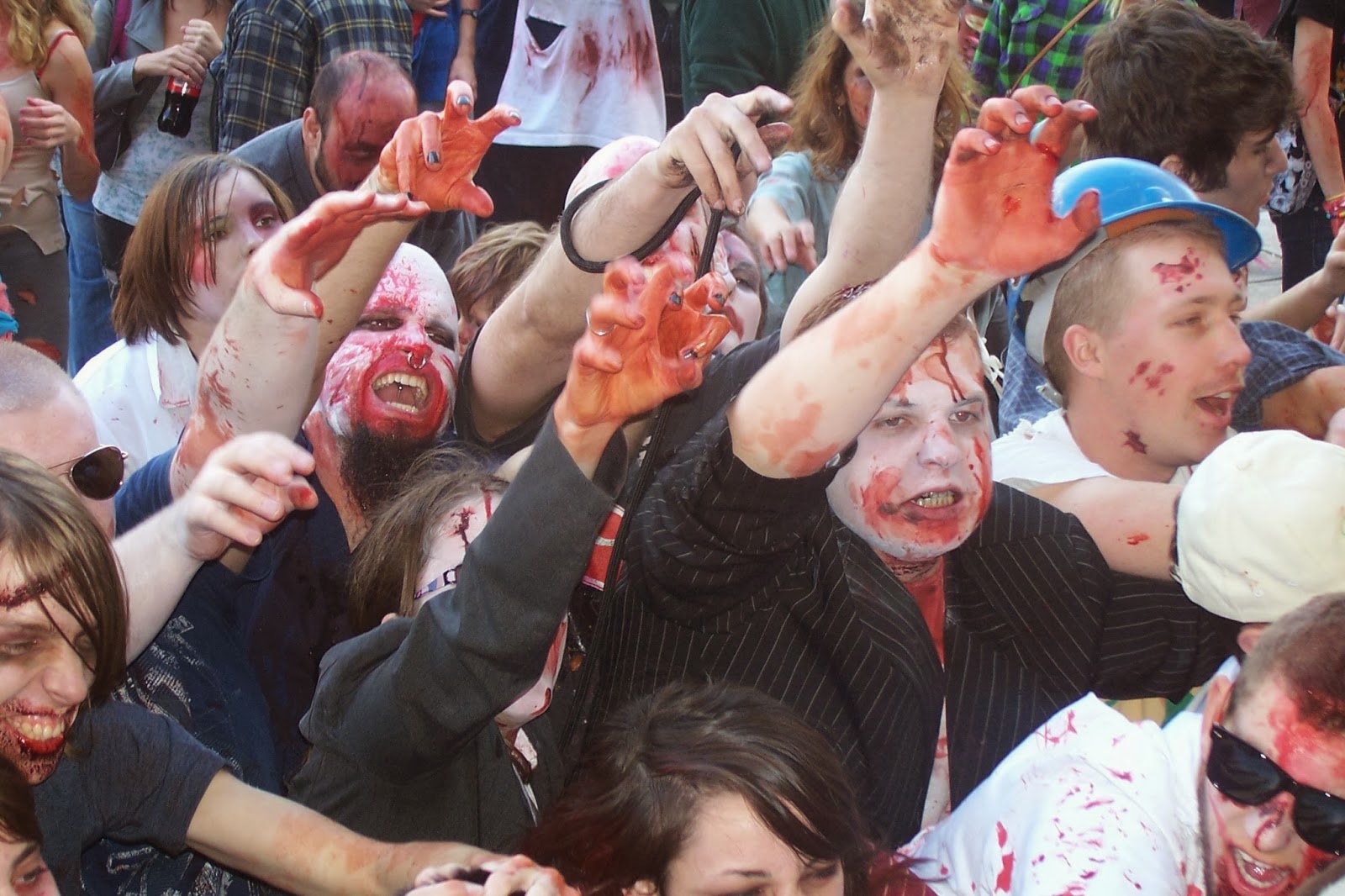
London, ON, 2011 Zombie Walk (Photo by Christine Boston)
The term zombie, also written as zombi, is popularly used today to refer to the “living dead,” or deceased individuals are reanimated, but this is just one of two primary definitions of the term zombie.  Zombies can also refer to souls that no longer have an associated body to reside in, which in Western cultural understanding is also known as a ghost.  For the purposes of this blog post, however, the former definition of a zombie (reanimated corpse) will be used. 

The physical zombie gained popular attention with the work of Canadian anthropologist Wade Davis.  Davis published two works, The Serpent and the Rainbow and Passage of Darkness, which detailed the discovery of Clairvius Narcisse, a Haitian man who was believed to be dead but was found years later alive.  His living after death state was immediately associated with his being a zombie.  Davis’s subsequent investigations determined that Narcisse was drugged with tetrodotoxin, puffer fish toxins, and held captive and enslaved as punishment for being a bad individual in “life”. 

Davis’s work initiated further research into the zombie phenomenon both in Haiti and abroad, and through this research a better understanding of the origins and meanings of zombies has been gained.  Zombies are now associated with the Voudon religion, which is a syncretic mix of African religions, Christianity, and other ideologies.  Zombies are largely associated with Caribbean, particularly Haitian, cultures but also found throughout African and some South American cultures, as well.  Zombie mythos are believed to have originated among African cultures and brought to the New World with the forced migration of Africans during the Slave Trade.  The mythos has since morphed among both Old and New World cultures as a result.  The central theme among all of these different cultural interpretations of zombies is that the zombie is an individual who was resurrected after death. 

London, ON, 2011 Zombie Walk (Photo by Christine Boston)
The creation of zombies is a contentious issue, particularly given the renewed fervor of zombies and the evolution of the mythos in Western cultures.  Among African and Caribbean cultures, it is believed that a zombie is created by a sorcerer who either curses or poisons an individual who dies shortly thereafter.  The newly deceased individual is the “resurrected” by the sorcerer, although many believe that the sorcerer merely excavates an individual who was buried alive.  The newly “resurrected” individual is characterized as having no memories, personality traits, or awareness of who they are or were and is, in essence, a “soulless” being.  The zombie is then enslaved by the sorcerer or to whomever the zombie is given or sold.  The mythos surrounding zombies goes further by stating that zombies should abstain from eating salt, or they will no longer be a zombie and therefore return to their graves or seek vengeance against the living.

But why does the zombie mythos exist and persist in cultures around the world?  There are many ideas out there, but it appears that zombies present a moral tale about the human condition and society at large.  For example, the Max Brooks book World War Z ignited a firestorm of controversy as it explored themes concerning human survival and altruism (or the lack thereof in many cases).  Film theorists believe that George Romero’s Night of the Living Dead was a commentary on the American political system and/or consumerism of the 1970s.  And among Haitian cultures, it is said that only “bad individuals” will become zombies as punishment for their misdeeds during life, as evidenced by the tale of Clairvius Narcisse who was portrayed as a ruthless man in life.  So while many different ideas about the purpose of zombie mythos exist, it appears that the most common theme is the tale of morality, however that is culturally defined.

Zombie Love, London, ON, 2011 Zombie Walk (Photo by Christine Boston)

References:

http://blogs.scientificamerican.com/anthropology-in-practice/2011/10/26/the-american-fascination-with-zombies/

Ackermann, H., & Gauthier, J. (1991). The Ways and Nature of the Zombi The Journal of American Folklore, 104 (414)  

A & E Documentary on zombies based on The Serpent and the Rainbow by Wade Davis

Personal Communications with zombie enthusiasts